Expertise over standard algorithms: Why your construction company needs more than just a digital tool
Expertise over standard algorithms: Why your construction company needs more than just a digital tool
AI, cloud, APIs, automation, digital interfaces, e-invoicing, Peppol, data exports, mobile time tracking – and ideally, of course, everything should communicate seamlessly with everything else.
Anyone looking into the digitalisation of a construction or trade business today is quickly confronted with a whole range of technical terms, new solutions and supposed “must-haves”. There is now a tool, platform or AI application for almost every problem. Analysing quotations, drafting texts, checking documents, transferring data: much of it is supposed to work with just a few clicks.
At first glance, that sounds tempting. But for businesses, there is a much more important question: what actually helps us in our day-to-day work – and what simply makes our processes more complicated?
After all, a construction project in Belgium or Luxembourg cannot be reduced to standardised fields in a piece of software. Different construction sites, employees, deadlines, working methods, customer requirements and a company’s own calculation methods mean that hardly any two businesses operate in exactly the same way.
Software therefore needs to do more than simply be technologically up to date. It needs to fit the company.

The digital toolbox: Support or added complexity?
Technological innovations offer enormous opportunities. AI can analyse and draft texts, automation can take care of repetitive tasks, and digital interfaces can exchange data between different systems.
But every new solution often brings a new set of questions.
Does the tool fit our existing workflows? Can we continue using our current data and calculations? Who sets up the interfaces? What happens when legal requirements change? And above all: who can we turn to when something doesn’t work?
An algorithm can recognise patterns and process information. What it doesn’t know is your company. It doesn’t know how your team works on site, what specific challenges a project in the Oesling or Wallonia may involve, or why certain processes have evolved the way they have over the years.
Your own tried-and-tested calculation methods are not outdated baggage from the past. They contain valuable knowledge and experience built up within your company.
So the key question is not: how many new technologies can we introduce?
It is: how can we turn them into a digital solution that fits our established workflows?
Construction software that speaks your language – right there in your company
This is precisely where the difference lies between an isolated software solution and working with FICOS.
When we talk about HIT-Online, we don’t just mean a user interface or a list of features. We mean construction management software built on an in-depth understanding of the processes used by construction companies and skilled trades.
Because successful digitalisation doesn’t start with the tool. It starts with the process.
We look at how your company actually works: from costing and quotation preparation to time tracking and site organisation, all the way through to invoicing and documentation.
That’s why we visit companies directly, sit down with managers and employees, and work together to identify where digital solutions can genuinely reduce the workload.
Not every new feature is automatically useful. What matters is whether it fits the reality of your daily work.
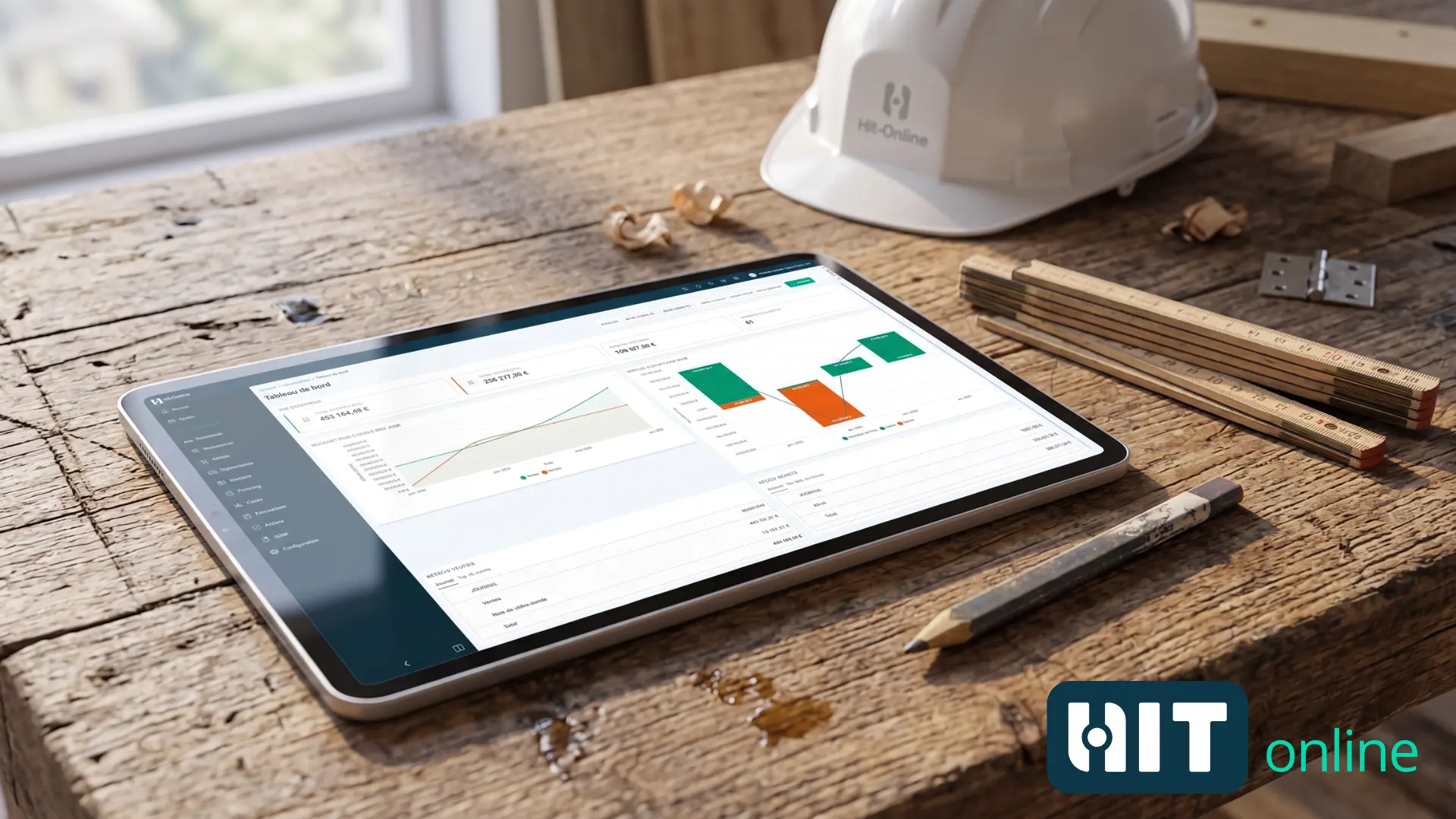
The 95% foundation: Tailored construction software instead of an off-the-shelf solution
Every construction and trade business develops its own working methods over the years. So why should new software suddenly turn all those processes upside down?
Our philosophy with HIT-Online is clear: for most customers, the software is already around 90 to 95% ready to use. At the same time, experience has taught us that the remaining few percent can make all the difference.
Because that is often where a company’s individual requirements are found.
Instead of telling you how you need to work in future, we look at how HIT-Online can be integrated sensibly into your existing processes. Necessary adjustments can be implemented directly or – in the case of more complex requirements – incorporated into one of our regularly released software versions.
HIT-Online therefore doesn’t evolve independently of its users. It evolves together with them.
This is particularly important because the conditions surrounding your business are constantly changing too. New requirements such as e-invoicing and Peppol show that companies cannot simply sit back and wait when it comes to digital developments. Our article on the potential €14,400 cost of waiting too long to prepare for Peppol shows what the consequences can be.
Your software should adapt to your company – not the other way around.
See how HIT-Online can fit into your existing processes during a personalised demonstration.
Personal software support – when technology suddenly isn’t so simple
Ideally, software simply works.
But in everyday business, there will always be situations where something doesn’t work as expected. An employee has a question. A setting needs to be changed. A new process needs to be mapped in the system. Or the company has an individual requirement that goes beyond the standard solution.
These are exactly the moments when you find out what a software provider can really offer.
With anonymous online tools, this often means searching through help centres, FAQs and ticketing systems. Perhaps a chatbot answers first. Perhaps your request eventually reaches a support team that knows neither your company nor the way you work.
At FICOS, we have deliberately chosen a different approach: personal support from people who know our software and understand our customers’ requirements.
- Directly in your company: We train your employees on site. This means your teams don’t learn some theoretical standard process, but how to use HIT-Online in the context of their actual day-to-day work.
- Direct assistance: If a problem occurs during your working day, we can, for example, connect via TeamViewer and work with you to find a solution.
- Individual requests: If your company has a specific requirement, talk to us about it. Together, we’ll look at how it can be implemented in a way that makes sense.
Digitalisation should make life easier for your employees – not force them to become software experts on top of doing their actual jobs.
Innovation through dialogue: Making digitalisation work for construction
The digital world is evolving rapidly. AI is becoming more powerful, processes are increasingly automated, and new legal requirements mean that construction software also needs to evolve continuously.
We follow these developments closely and assess which technologies can deliver genuine added value for HIT-Online and our customers.
But one principle remains essential to us: technology is not an end in itself.
Software isn’t automatically better because it offers more features, more automation or more artificial intelligence. It is good software when it makes everyday work simpler, more transparent and more efficient.
That also means connecting a company’s core processes: costing, quotations, time tracking, construction sites, documentation and invoicing shouldn’t operate as separate digital islands.
We’ve also summarised what modern construction software should actually be capable of in our article “What should construction software be able to do?”.
And anyone who has already experienced software that promises a great deal on paper but doesn’t work properly within their own company knows that choosing new software should never be based on a feature list alone. You can read more about this in our article on avoiding the wrong software choice and switching to HIT-Online.

Conclusion: Good construction software doesn’t end at the login screen
Modern technology can take a considerable amount of work off the shoulders of construction companies and skilled trades. At the same time, the digital landscape is becoming increasingly complex. AI, interfaces, automation and new legal requirements will continue to create new opportunities – and new questions.
That’s why we at FICOS believe that companies today need more than simply access to a piece of software.
They need a personal contact.
Someone they can ask when a feature isn’t clear. Someone who looks at the situation together with them when a problem occurs. And someone they can talk to about individual requirements when their company simply doesn’t fit into a standard template.
That’s exactly what our team at FICOS is here for.
HIT-Online provides the digital foundation. Our personal support makes sure it works for your company.
Because at the end of the day, you shouldn’t have to become an AI expert, an interface specialist or a software technician.
You should be able to focus on what you do best: running your business and delivering successful projects.
Would you like to find out how HIT-Online can fit into your company’s processes? Let’s discuss your requirements and show you HIT-Online in a personalised demo →
See HIT-Online in action.
30 minutes is all it takes to see how HIT-Online can adapt to your company’s processes.