Electronic invoicing in Luxembourg: Turn the Peppol requirement into an advantage for your business
Electronic invoicing in Luxembourg: Turn the Peppol requirement into an advantage for your business
B2B electronic invoicing is coming to Luxembourg. From 2028 onwards, companies will gradually have to adapt the way they receive and issue invoices.
But the real challenge will not simply be the ability to send or receive an invoice via Peppol. It will be to adapt your processes without creating additional administrative work.
An invoice arrives via Peppol: what happens next? Do certain details still need to be entered manually? How is the invoice linked to the right supplier and the right project? How is it checked? And how are the data then transferred to accounting?
At Hit-Online, we believe electronic invoicing should not add another layer of administration. On the contrary, it should simplify existing processes.
And for us, Peppol is no longer something new. Thanks to our experience in the Belgian market, where B2B electronic invoicing has been mandatory since 1 January 2026, we have already integrated Peppol into our users’ daily workflows. We are now bringing that experience to companies in Luxembourg.
2028: What will electronic invoicing change in Luxembourg?
Luxembourg already uses electronic invoicing in transactions with the public sector. The next step will concern B2B exchanges between private companies.
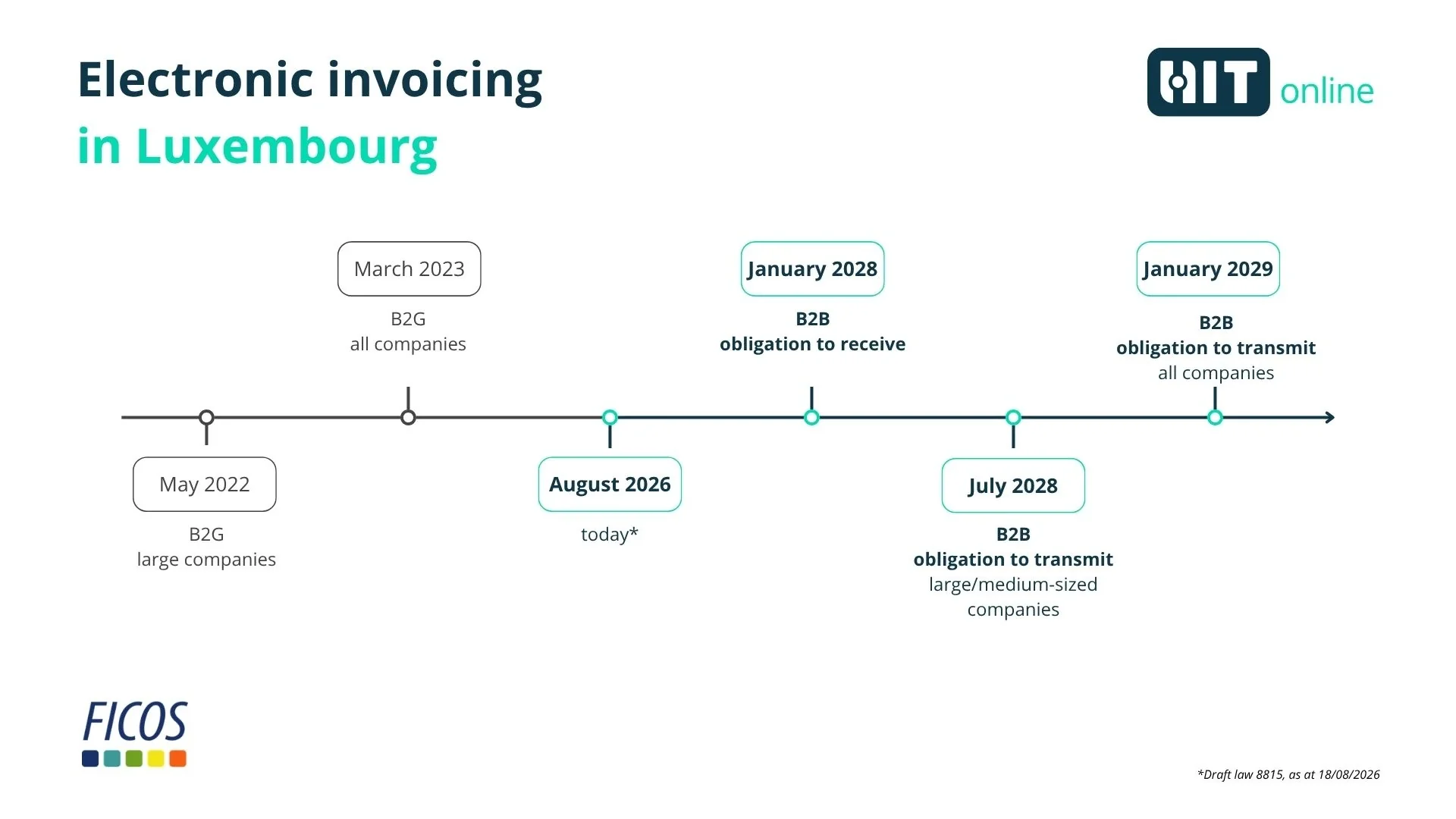
According to the current timetable, all Luxembourgish companies will have to be able to receive electronic invoices from 1 January 2028.
From 1 July 2028, large and medium-sized companies are also expected to be required to issue their B2B invoices electronically. This obligation is then expected to extend to small and micro-enterprises from 1 January 2029.
The planned changes and timeline have been covered by Paperjam in its article on the future B2B electronic invoicing obligations. Digiteal has also examined the upcoming changes in Luxembourg and the role Peppol is expected to play in this new environment.
For companies, however, the key question is less technical: how can this new way of invoicing be integrated into the processes that already exist?
A new obligation should not create more administrative work
Many companies still receive invoices by email as PDF files. These then need to be checked, recorded, assigned and forwarded to the right people or to accounting.
With Peppol, the transmission channel changes. Invoice information is sent in a format that software can process directly.
But simply changing the channel is not enough.
If the invoice first arrives in a separate system and then still has to be processed manually in your management software, the problem has only been moved elsewhere. Electronic invoicing then becomes an additional obligation instead of a real improvement.
The goal should be exactly the opposite: less data entry, fewer intermediate steps and a smoother invoice process.
That is the approach we have chosen for Hit-Online.
If you would like to understand in more detail what happens when an electronic invoice is sent and received, we explain how electronic invoicing works in a dedicated article.
With Hit-Online, Peppol fits into the way you already work
Our goal is not simply to make Hit-Online compatible with Peppol. We want you to continue working in your familiar environment without having to create a separate process for electronic invoicing.
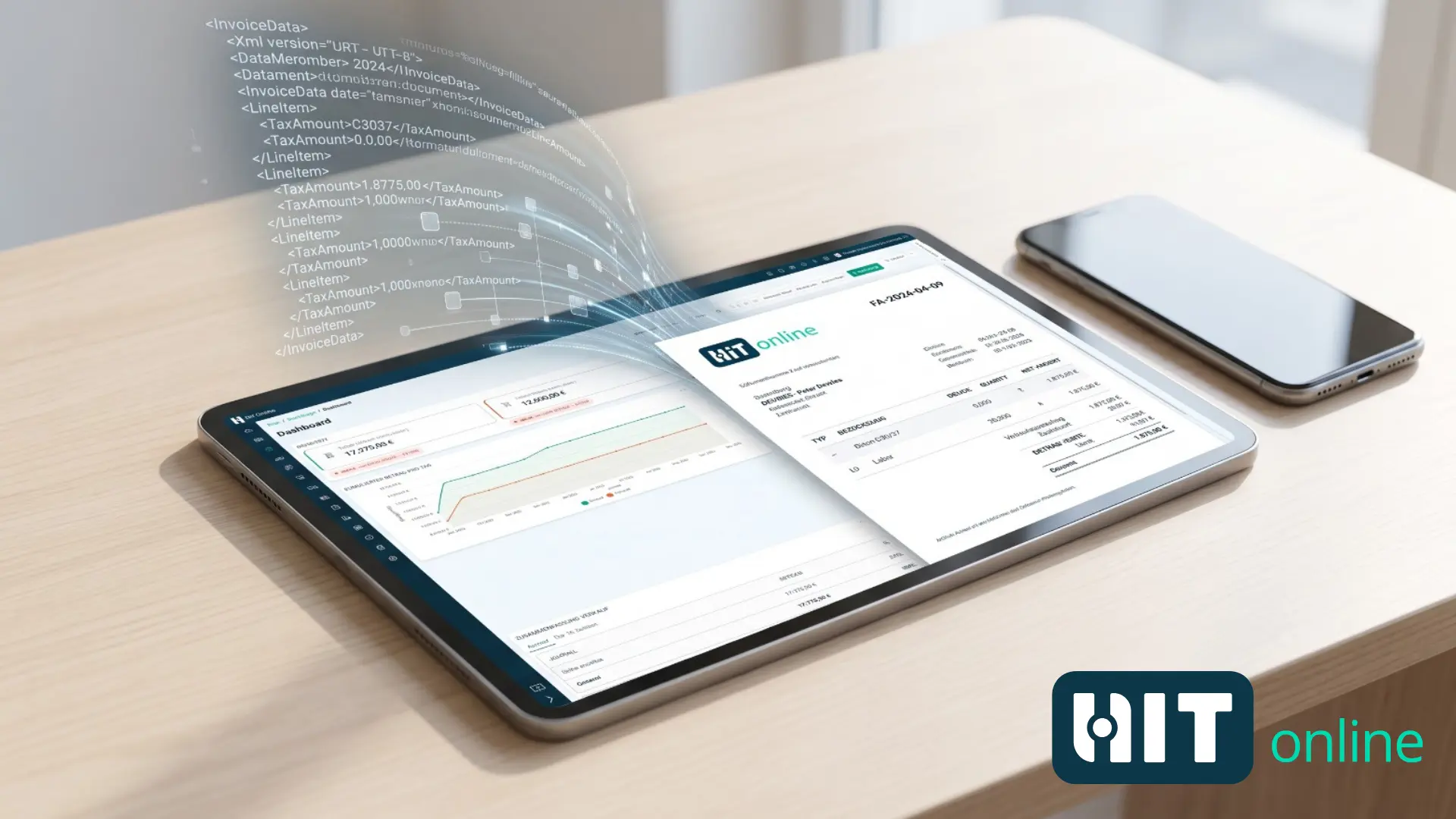
When a purchase invoice arrives via Peppol, its data can be used directly in Hit-Online. This means you do not have to manually re-enter information that is already available.
The process can then continue exactly where you actually need the data.
For a construction company, this means, for example, being able to allocate costs to the relevant project. An invoice can be assigned entirely to one project or its individual lines can be distributed across several projects. The information can then continue through to accounting.
The invoice is therefore not an isolated element: it becomes part of your day-to-day management.
This is where electronic invoicing becomes genuinely valuable. It does not simply replace a PDF sent by email. It allows you to make better use of data that is already available and reduce repetitive administrative tasks.
We look at these benefits in more detail in our article on saving time with electronic invoicing.
Peppol without a separate parallel process?
Discover how Hit-Online integrates electronic invoicing directly into your day-to-day management.
Less data entry, fewer manual checks, fewer risks of error
Effective automation should also take care of the small tasks that repeatedly take up time in everyday work.
When a new supplier sends you an invoice, their information is already included in the received data. Depending on your configuration, Hit-Online can use this information to create the supplier automatically instead of requiring you to enter everything manually.
The software can also alert you when a received invoice appears to match a document that already exists. You can then check the potential duplicate before continuing with the process, helping to reduce the risk of processing or paying the same invoice twice.
And what if your supplier does not send a PDF together with the invoice? Hit-Online can automatically generate a PDF representation so that your employees can easily view the content.
These are different functions, but they all serve the same purpose: to eliminate work that can be automated.
Luxembourg is preparing. We already have the experience.
For Luxembourgish companies, the B2B obligation is still ahead. For Hit-Online, electronic invoicing via Peppol is already part of everyday business.
In Belgium, B2B electronic invoicing has been mandatory since 1 January 2026. We have therefore already supported our users through this transition and adapted Hit-Online to situations that actually occur in companies’ daily work.
That experience makes a difference.
We are not developing a theoretical solution today that is only expected to be ready when Luxembourg introduces its new requirements. The processes already exist and are being used in a market where B2B electronic invoicing has become a reality.
You can also read more about how we prepared for mandatory electronic invoicing in Belgium.
Luxembourg will of course have its own requirements and its own timetable. Our task now is therefore to use the experience gained in Belgium to provide a solution adapted to the reality of Luxembourgish companies.
For construction companies, integration makes the difference
In a construction company, a purchase invoice contains information that is relevant not only to administration or accounting.
It also represents costs that need to be linked to the corresponding projects.
That is why electronic invoicing integrated directly into company management creates much more value than a solution designed only to send and receive invoices.
With Hit-Online, the data can flow continuously through your existing processes: from receiving the invoice to checking it, allocating costs to the project, tracking its status and transferring the information to accounting.
If you manage both purchases and sales in Hit-Online, certain lines from a purchase invoice can also be transferred to a sales invoice.
The principle is simple: information that is already available in your software should not have to be entered a second time.
You save time, reduce manual steps and maintain a better flow of information between administration, projects and accounting.
2028 should not become a last-minute project
The first deadlines planned for 2028 may still seem some way off. But waiting until the final months means having to change your processes at exactly the same time as many other companies are facing the same challenge.
Preparing earlier, on the other hand, allows you to integrate Peppol gradually into your organisation.
Your employees can become familiar with the new process, you can identify any necessary adjustments in advance and start benefiting from electronic invoicing before the B2B obligation applies to your company.
When the new rules come into force, Peppol will no longer be a project that needs to be implemented under time pressure. It will already be part of the way you work.
Turn an obligation into an advantage with Hit-Online
Electronic invoicing is coming to Luxembourg. You can see it as a new technical requirement your company will have to comply with from 2028.
Or you can use the transition as an opportunity to simplify your processes.
With Hit-Online, you are not simply preparing your company for Peppol. You are integrating electronic invoicing into software that already connects your invoices, projects and accounting.
Our experience in Belgium has allowed us to test this approach in the day-to-day reality of companies. We are now ready to bring that experience to the Luxembourgish market.
Less manual data entry, smoother processes and invoicing directly integrated into your management: that is how an obligation can become an opportunity to improve the way you work.
Would you like to prepare your company for Peppol without adding more administrative work?
Request a Hit-Online demo and discover how to integrate electronic invoicing into your processes.
Prepare your business for Peppol.
Discover how Hit-Online integrates electronic invoicing into your day-to-day management.