CIaO in the Belgian construction sector: what changes on 1 April 2027

CIaO in the Belgian construction sector: what changes on 1 April 2027
From 1 April 2027, Check In and Out at Work will become mandatory on affected construction sites in Belgium. Workers will have to register the beginning and end of their work, as well as their breaks, in real time. Which construction sites are affected? What responsibilities do companies have? And how can Hit-Online turn this new obligation into an operational advantage?
In an earlier article about CIaO, we explained why the introduction of mandatory check-out could also represent an opportunity for construction companies.
Since that first publication, the NSSO has clarified the official timetable. Here is what companies now need to know.
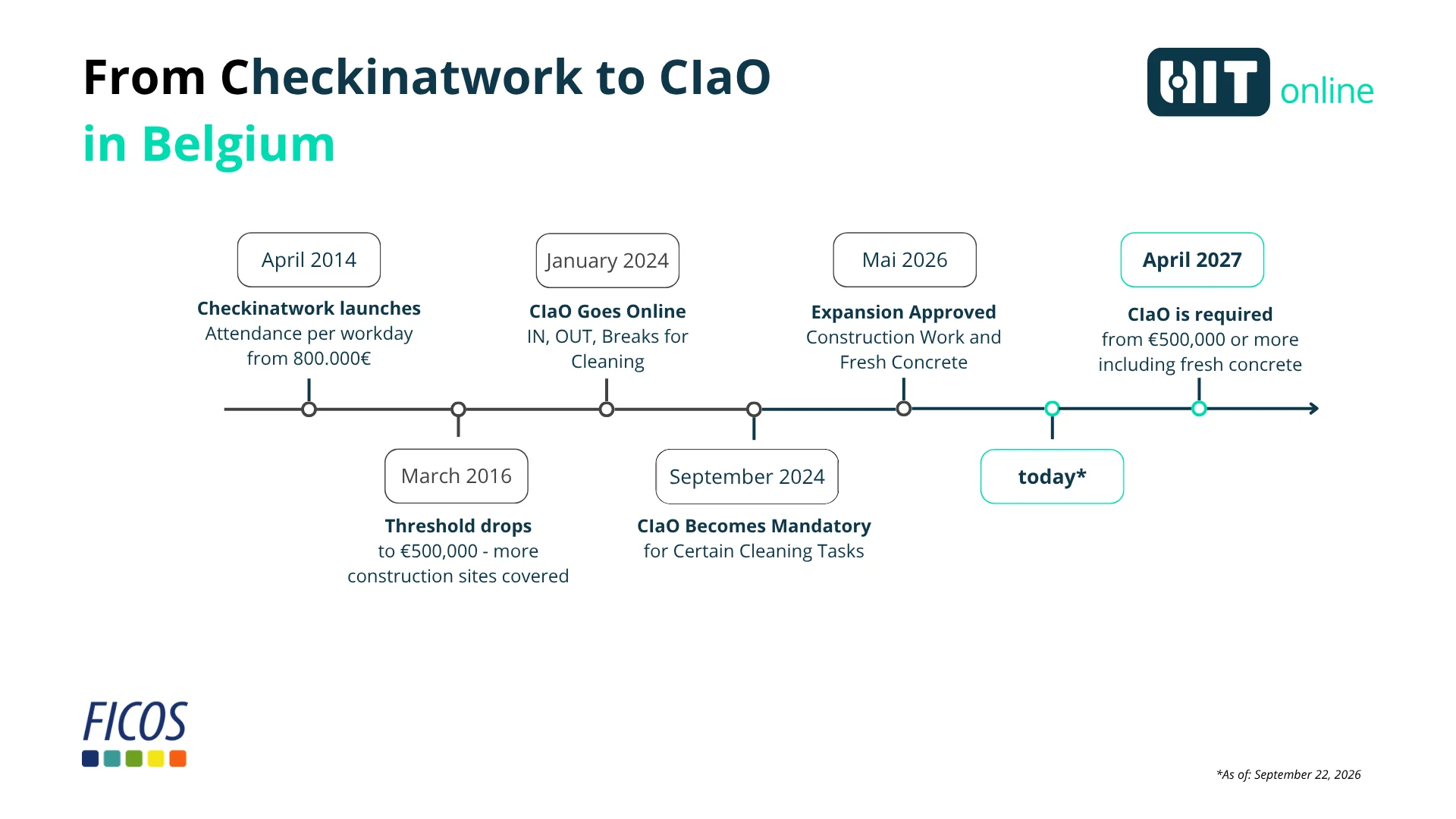
From Checkinatwork to CIaO: what is changing?
CIaO stands for Check In and Out at Work. It is the attendance registration system provided by Belgium’s National Social Security Office, the NSSO or ONSS.
Companies currently use Checkinatwork to register a person’s attendance on an affected construction site each day before work begins.
From 1 April 2027, CIaO will take over for the affected construction activities. A single attendance registration at the start of the day will no longer be sufficient.
Each person concerned will have to register in real time:
- IN when work begins;
- OUT when a break begins;
- another IN when work resumes;
- OUT when the work ends.
From that date, Checkinatwork can no longer be used to register attendance for the affected construction activities.
This extension results from the Programme Act of 30 May 2026, Title 6, Chapter 1, Articles 124 to 131. CIaO has already been used for certain cleaning activities since 1 September 2024. In April 2027, it will be extended to the affected construction activities and the delivery of ready-mixed concrete.
Official information and future updates are available on the Belgian Social Security CIaO page.
Which construction sites and people are affected?
The obligation will apply to workplaces where construction activities with a total value of at least €500,000 excluding VAT are carried out.
The total value of the work performed at the location concerned must be taken into account. The obligation may therefore apply:
- from the beginning of the project if the threshold has already been reached;
- during the project as soon as the total value subsequently reaches €500,000 excluding VAT.
The new rules also cover the delivery of ready-mixed concrete.
Registration does not only apply to employed construction workers. According to the information currently published by Social Security, it includes:
- employees;
- self-employed workers;
- temporary workers;
- trainees concerned by the rules;
- employees and self-employed workers of subcontractors.
Foreign companies carrying out construction activities in Belgium may also be affected.
Declaration of Works and CIaO: two different obligations
The Declaration of Works under Article 30bis and CIaO registration are related, but they should not be confused.
A Declaration of Works may already be required for a project worth considerably less than €500,000. This does not automatically mean that the site is also subject to CIaO.
For construction activities, the announced threshold for mandatory CIaO registration is €500,000 excluding VAT.
Shared responsibility throughout the subcontracting chain
Responsibility for registration lies both with the company that sends a person to work and with the person carrying out the work.
The company must, in particular:
- inform the workers concerned;
- provide them with a suitable means of registration;
- organise the process on the construction site;
- ensure that the data is transmitted correctly;
- monitor registration throughout its subcontracting chain.
The person carrying out the work must correctly register the start and end of work and all breaks at the appropriate time.
For the main contractor, the issue therefore extends beyond the time tracking of its own employees. It must also maintain an overview when several teams, self-employed workers and subcontractors are active on the same construction site.
The more complicated the process, the greater the risk of missed registrations, errors and duplicate data entry. A simple tool for the people on site therefore becomes an essential factor in achieving compliance.

With Hit-Online: one click, three uses
An additional obligation should not mean that construction workers have to use an additional app.
With Hit-Online, users record their time directly in the environment they already use for their daily work. They do not have to enter the same information into several separate systems.
One action makes the data available for three different purposes.
1. Mandatory reporting to the NSSO
The time entry provides the information required for CIaO registration. Users do not have to interrupt their work to open a second application and repeat the same action.
2. Data for payroll processing
The recorded hours are also available for monitoring work performed and preparing payroll.
The administrative team no longer has to collect, compare and manually copy working hours from paper timesheets, messages or separate files.
3. Construction project cost tracking
Working time is assigned directly to the relevant project and activity.
The recorded hours can therefore be used to:
- monitor labour costs;
- compare actual hours with planned hours;
- improve post-calculation;
- identify deviations sooner;
- analyse the profitability of individual projects.
One click on a smartphone. Three uses: NSSO, payroll and construction project costs.
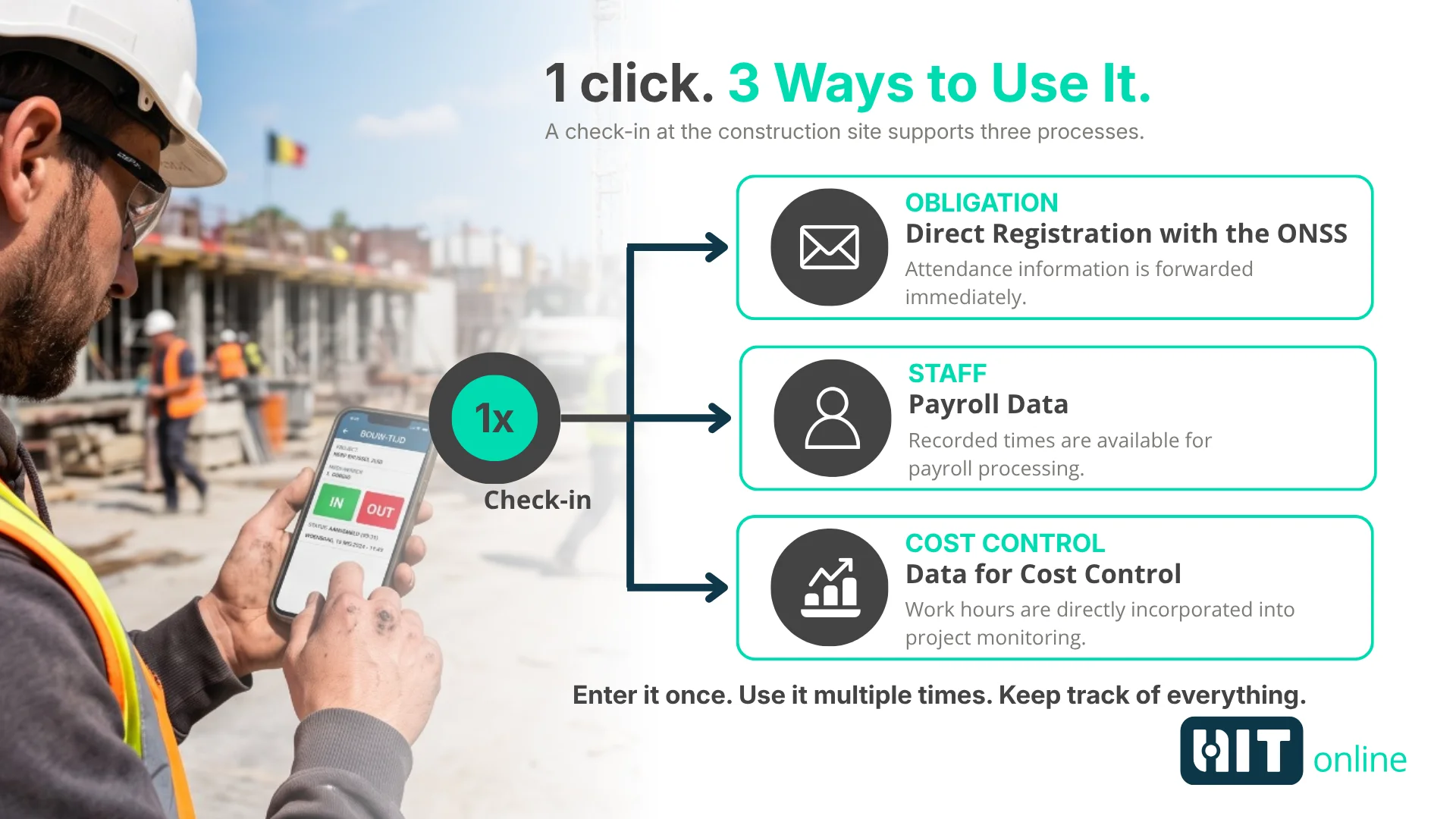
One time entry, three uses.
Discover how Hit-Online connects CIaO, payroll preparation and construction project costs.
The practical benefits for your company
Integrating CIaO into Hit-Online does more than help your company comply with a new obligation. It improves the entire flow of information between the construction site and the office.
Fewer steps for workers
Workers record their time in one application. They do not have to decide which system to open or enter the same information more than once.
A simple process is easier to explain, more likely to be followed consistently and easier to integrate into daily routines.
Less duplicate data entry in the office
The same data is used for several processes. The administrative team does not have to transfer working hours manually from one system to another.
This saves time on repetitive work and reduces transcription errors.
More consistent data
When regulatory reporting, work records and construction project costs are all based on the same time entry, the company avoids working with several versions of the same information.
The hours used for payroll correspond to the hours allocated to the project and to the data recorded on site.
Faster payroll preparation
Work records are available without waiting for paper timesheets to be returned or spreadsheets to be completed at the end of the week.
The administrative team can check the data earlier and intervene when information is missing or appears inconsistent.
Better control of project costs
Hours are assigned directly to projects and activities. Project managers therefore do not discover discrepancies only after the work has been completed.
They can compare the budget with actual performance sooner, identify overruns and take action before they become too significant.
An overview across multiple construction sites
Hit-Online centralises information from the field. The company can monitor teams and projects without manually combining data from scattered sources.
This overview is particularly valuable when several construction sites are active at the same time.
Clearer monitoring of subcontractors
On a construction site subject to CIaO, the main contractor must also take account of the companies and self-employed workers in its subcontracting chain.
Centralised management makes it easier to monitor registrations and identify missing information sooner.
No isolated additional system
CIaO does not become another database disconnected from the rest of the company. Registration is integrated into the existing management process.
The legal obligation becomes the starting point for information that can be reused throughout the organisation.
One entry on site, less administrative work and greater visibility into project profitability.

Why prepare for the transition now?
1 April 2027 may still seem some way off. However, the move from Checkinatwork to CIaO will change daily routines on the construction sites concerned.
Companies should start now to:
- identify construction sites that reach or may reach the threshold of €500,000 excluding VAT;
- determine which employees, self-employed workers and subcontractors are affected;
- review their existing time-tracking processes;
- prepare their teams for IN and OUT registration;
- define responsibilities in the event of missed or incorrect registrations;
- organise the monitoring of subcontractors;
- prepare integration with the systems used on site and in the office.
The NSSO has announced that further information on the practical application to construction activities will be published. Companies should therefore continue to monitor the technical requirements.
The basic principle, effective date and threshold are already known. Teams and internal processes can therefore be prepared without waiting until the final few weeks.
Prepare for CIaO with Hit-Online
With Hit-Online, CIaO does not become another isolated obligation. Time tracking becomes part of one continuous workflow:
- the construction worker performs one action on a smartphone;
- the required information is used for reporting to the NSSO;
- the hours are available for payroll preparation;
- working time is allocated to construction project costs;
- managers receive consistent information for controlling their projects.
The company saves time, reduces duplicate data entry and gains better visibility into work performed and profitability.
One simple action for the worker. Three uses for the company.
Would you like to prepare your company for Check In and Out at Work?
Request a Hit-Online demo and discover how CIaO can be integrated into your time tracking, payroll preparation and construction project management.
Prepare your company for CIaO.
Discover how Hit-Online connects time tracking, NSSO reporting, payroll and construction project costs.